Aug 30, 2020 | Not on Home, Uncategorized
Home Owners: Sandy Rowland and Tim Hauser

Tour Highlights:
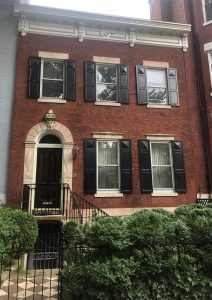
24 9th Street, NE
★ Spectacular rug collection, several from Weschlers Auctioneers and Appraisers
★ Skylights in upstairs hallway and bathroom
★ The main front and rear bedrooms have their original “chimney closets”, an extravagance when the house was built since closets were taxed as separate rooms.
★ Bedspread in the master bedroom belonged to the owner’s maternal grandmother.
Fun to Find:
★ Hindu god Ganesha holding an umbrella
★ Tiny teddy
★ Eagle with outstretched wings
House Description:
Built during the Civil War, this home is one of the earliest brick houses on the square. At that time, the house would have been surrounded by fields, pasture, and a scattering of frame houses. Richard Rothwell, a prominent builder and marble cutter/stonemason, designed his family’s home to reflect not only his profession and the materials he knew so well but also the Civil War period before the more exuberant Victorian architecture became fashionable on the Hill. Rothwell and other family members worked on a number of prominent Washington buildings such as the Patent Building, Pension Building, Capitol Extension (north and south wings), Treasury Building’s west wing, and cenotaphs and private memorials at nearby Congressional Cemetery before turning their attention to the burgeoning residential development on Capitol Hill of the 1870s.
Façade: If you are ever walking by this house, stop a moment and consider some of its unusual features such as the 22-foot-width instead of the standard 18 feet. The eye-catching checkerboard marble and red-and-grey slate pavers connecting the sidewalk and the stoop are original to the house. The marble front door surround with its unusual paneling is completed by the arch with the Green Man keystone (believed to have come from England). Marble — not a typical Capitol Hill residential material — is also seen on the graceful, curving steps, the entrance to the English basement, and the stone foundation cladding. One last reminder of life in the 19th century is the coal cellar under the northern half of the front garden, detected by the coal grate that would have been lifted and then anthracite coal shoveled in.
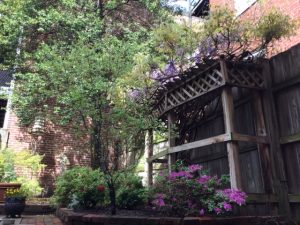
24 9th St NE Patio
English basement: When built, the English basement was the main family area of the home since this is where the kitchen and dining area were located. In the 1989/90 renovation of the English basement, the present owner preserved the kitchen (while updating the appliances), making a conscious choice not to move the dining room to the main floor as has been done in most Capitol Hill renovations. The front half of the downstairs has been turned into a formal dining room with a late 19th-century French mantel. An 18th-century American Federal convex mirror hangs just inside the door. The center window was extended downward to create a floor-to-ceiling opening to match the flanking all-glass doors. Old French doors were installed between the dining room and the rear kitchen area, and there is also a concealed door to the basement bathroom.
In the kitchen area, a rear fireplace was reopened and an 1880s walnut mantel installed.
The furnace was updated and moved to the side with the hot water heater and washer/dryer, forming a small utility and tool area adjacent to a new bathroom. In front of the fireplace is a mid-18th-century drop-leaf, gate-leg table, set on a diagonal to the room
First Floor: The entrance hallway is exceptionally wide and long with pocket doors to the double parlors. The window frames in the front of the house are unusual in that they are all angled out to provide maximum light. The floors in the parlors and throughout the first and second floors are original, variegated-width, heart- of-pine plank floors.

The front parlor marble mantel-piece is original to the house and probably imported from England. The ceiling rosettes and mouldings were added in 1983. Gaslight chandeliers and sconces in the
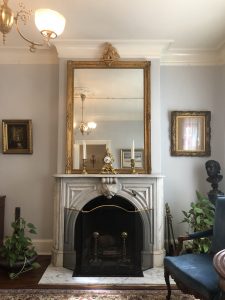
Front Parlor Marble Mantel-Piece, Original to the House
hallways, stairwells, and parlors are period from Boston and true to the house based on the gas pipe mains remaining in the attic and buried in plaster throughout the house. The front parlor chandelier from 1865 includes rare etched-glass shades. The Chippendale-style mahogany arm chairs date to the late 19th century and those upholstered in blue are fruitwood, circa 1900.
A late 18th- or early 19th-century George lll tall case clock highlights the second parlor. The doorway to the rear bathroom was probably a window before the rear section of the house was added in the late 1880s and, in fact, is the same width as the rear parlor windows. The bathroom contains an 1870s marble-top chest, adapted as a vanity, and mirror plus period wall sconces.
Second Floor: The staircase leading to the second-floor bedrooms is an interesting configuration that doubles back on itself from a midpoint landing. The house originally had no plumbing upstairs; a large window similar to the other upstairs rear windows graced the landing where the door to the upstairs bathroom is now located. The upstairs bathroom was added in 1985 and contains another 1870s marble-top chest, adapted as a vanity, and a mirror flanked by period wall sconces.
The stained-glass skylight in the bathroom was designed by the present owner and built by his father. With the addition of the upstairs bathroom and resulting loss of a rear window, a skylight was opened over the staircase. The skylight was also designed by the present owner and built by his father using antique German glass.
 The age of the house is immediately apparent from the sag in the second-story floor and the accompanying droop in the door frame to the small front bedroom. This bedroom, currently a study, was undoubtedly used for infants and very young children since another doorway (also slightly drooping!) connects the room to the main front bedroom. The bedspread in the master bedroom belonged to Sandy’s maternal grandmother who crocheted lovely things. This could have been made by her or by one of her friends; they were all Italian immigrants who came here in the early 1900s. The door connecting the two front bedrooms contains the original, restored lock hardware. Just outside, in the hallway, is a jackwood-and-ebony Chettiar merchant trunk from Tamil Nadu, India.
The main front and rear bedrooms have their original chimney closets, which would have been an extravagance when the house was built since closets were taxed as separate rooms. All the other  closets that exist in the house today have been added in recent times.
24 Ninth Street remained in the hands of the Rothwell family from 1862/63 until the estate of Sarah Rothwell, wife of William Rothwell (Richard’s eldest son), was settled in 1938. In March 1938 ownership passed from the heirs of Sarah Rothwell to Laura and Lydia Bowman. In November 1956 Laura Bowman sold the house to Adeline Gier Smith. In November 1982 Smith sold the house to Timothy P. Hauser, the present owner.
An in-depth history of the house and the Rothwell family can be found here.
Aug 30, 2020 | Not on Home, Uncategorized
Home Owners: Cathi & Phil Smith

Tour Highlights:
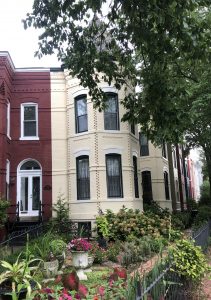
102 13th Street, NE
★ Phil built all of the upper glass-front kitchen cabinets and the butler pantry.
★ The speaking tube, a Victorian communication device still in use today (on the wall near the refrigerator) connects to the second-floor hall.
★ Phil’s grandfather collected clocks, including the 1905 Norwich Linen model manufactured by the New Haven Clock Company in the guestroom.
★ Phil and Cathi were married in Florence, Italy in 1989. Bright red banners advertising a charity dinner hung from light poles all around the city. After the event, a worker cutting them down happily gave one to them. The plate and glass under the banner were used at the charity dinner served on the streets of Florence.
Fun to Find:
★ A 1926 photo of Cathi’s father and his twin brother on a toy cow (first shelf of book case). A later photo shows the boys riding a pony.
★ The 80-plus-year-old Teddy Bear belonged to Phil’s older brother, who died of pneumonia while still an infant. The bear became Phil’s when he was born.
★ The roosters and Russian dolls on the kitchen shelves and an apology from Frankie on the fridge.
★ The reflection of the camera that records the tour
★ Find the speaking tubes, upstairs and in the kitchen! Helllloooo?
House Description:
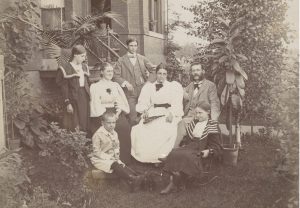
The Franke Family on June 27, 1896
These walls did talk. Fifteen years ago, the owners of this corner house overlooking Lincoln Park noticed three people looking intently at the outside of their residence. One of the visitors, Jean Colison, explained that her mother was the granddaughter of the original owner. She had come to see the house, along with her mother Lois Colison and her brother Warren.
“You must be the Frankes,” Phil exclaimed. “I have your mail!” Mrs. Colison was indeed the granddaughter of Friedrick Maximillian Franke (1844-1900) and his wife Lisette Maria Kandler (1852-1925), who had purchased the house in 1892. Her mother, Hilda, was one of the Franke’s five children.
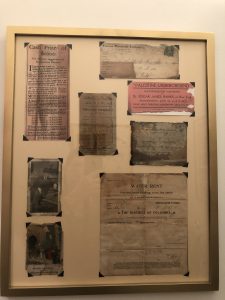
Treasures Found In the Walls
While renovating the house, the Smiths discovered mail addressed to all seven members of the Franke family in the door and window casings, where it apparently had been placed to stop drafts. Also found were documents such as the paid receipt for “Water Rent” of $3.75 for the year 1903 and Albert Franke’s library card. A few examples are framed in the powder room.
Frank Wickline built the Queen Anne-style row house in 1892. The Permit to Build from the District of Columbia Inspector of Buildings and the Special Application for Projections beyond the Building Line by the Department of War were approved on December 1, 1891. The house and the adjoining residence on North Carolina Avenue were constructed together and were valued at $4000.
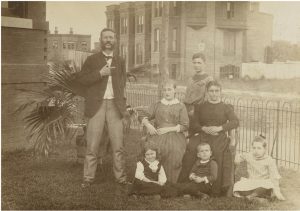
The Franke Family in an earlier photo
The Frankes financed the house with a loan from the German-American Building Association, the name of which is still engraved on the building at the northeast corner of 3rd Street and Independence Avenue.
The Colisons provided documents and photos including a June 27, 1896 family portrait in front of the house that now hangs in the vestibule along with an earlier, undated photo showing only four houses on the street. There is also a 1904 photo of Mrs. Franke (a milliner) and a friend in their elegant hats taken from the corner.
Max Franke, an engraver born in Germany, was the first owner. He migrated to Michigan at the age of 25 and moved to Washington, DC in the early 1880s. Two of his engravings of The Capitol at Washington are in the Library of Congress. A downloaded copy of one is framed in the vestibule.
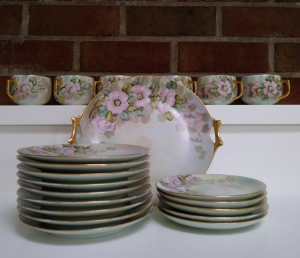
L.S. Fluckey Hand-Painted Fine China
In 1909, the house was sold to Lulu Fluckey (1872-1934), an artist whose beautiful hand-painted fine china is still collected today. Known professionally as L.S. Fluckey, she was an artist for Limoges and other premier porcelain makers of the day. Her son, Rear Admiral Eugene B. (Lucky) Fluckey, was awarded the Medal of Honor for his valor in WW II. The house was then owned by her daughter Frances Lucille Fluckey Clarke, who sold it in 1938. Afterwards, there was a series of owners ending with Philip and Catherine Smith, who purchased 102 13th Street (once 2 13th Street), NE, in 1990. The house originally had four bedrooms and one and one-half baths. It was remodeled and updated in the early 1990s. The basic floor plan was retained except for the bathrooms. One bedroom was converted into two bathrooms. The half-bath, which was in the kitchen, was removed to enlarge the kitchen. The back hall to the kitchen was closed and part of the hall became a powder room.
 To the left of the center hall is the living room with an octagonal bay, curved corners, and a view of Lincoln Park. To the right is the dining room. The china cabinet in the recess had to be completely rebuilt.
The pocket doors to both rooms were found in the basement. One door of each set had approximately one-third of the top panel cut out, where a window had been inserted. Why? No one knows. The two solid doors were reinstalled to the living room and the two others, with replacement glass, in the dining room.
The swinging door to the kitchen was also found in the basement. It was not the original door so the Smiths enlarged it with molding to fit. They also built the glass-fronted kitchen cabinets. A door opens off the kitchen to the patio.
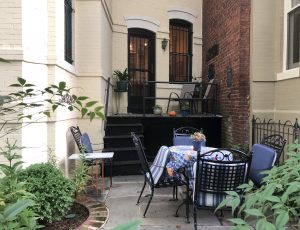
102 13th Side Patio
On the second floor, the room above the living room is a bedroom/den. The room above the dining room serves as the master bedroom. Phil’s mother nursed her children in the rocking chair.
Above the kitchen is the third bedroom with a curved wall and odd angles. The room is filled with light from its three windows and skylight. The oak dresser was inherited from Phil’s grandparents. The steamer trunk belonged to Cathi’s grandfather who lived with her family. He always filled it with Fifth Avenue and Mounds candy bars. The children could have as many as they wished when their parents weren’t looking. The right wall of the second floor hall has the end of a “Speaking Tube,” a Victorian means of communicating between floors, still used by the Smiths today.
The Smiths have now lived on Capitol Hill for over 30 years. They love living in our beautiful neighborhood and plan to age in place here.
Aug 22, 2020 | Not on Home, Walking Tours
New additions! In anticipation of our first-ever Virtual House and Garden Tour, we are collecting mini cell phone videos (< 2 min) of neighbors talking about some feature of their home that they think would be of particular interest or that they’re particularly fond of. (more…)
Aug 22, 2020 | Calendar, Not on Home, Preservation Cafés
Whose Land is it Anyway? The Public Squares and Parks of Capitol Hill
On Wednesday, September 16, 2020 at 6:30 pm, Justine Bello, an Architectural Conservator, will discuss this important topic at our first-ever virtual Preservation Cafe. (more…)
Jul 15, 2020 | Not on Home, Uncategorized
Home Owner: Patrick Crowley

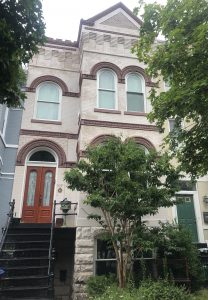
630 E St NE Front
Tour Highlights:
★ Faux finishes on living room, dining room and master bath walls, powder room ceiling, and on doors throughout the house
★ Kitchen light fixture constructed of water pipes and custom bulbs
★ Drawings made by home-owner in second floor hall
★ Skylight in master bath
Fun to Find:
★ Panama Hat
★ Globe Collection
★ Stained-Glass Kite
House Description:
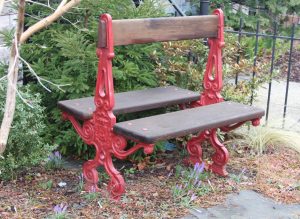
630 E St NE Naval Bench
630 E Street, NE, celebrates the out-of-the-ordinary. The fun begins in the front yard with a bright red, double-faced bench. Found in a Denver antique store, the bench’s naval-themed bas-relief motif was rediscovered after many layers of lead paint were striped away. An easily overlooked sailing ship hides on the side of the red legs. The bench isn’t in its final resting place, however. Patrick Crowley, the home owner, has decided this bench will be installed above his gravesite, “so others might rest in peace.”
Don’t let this 1881 structure fool you; the only old thing left inside is the molding around the front door and windows. Everything else dates from the 1999 renovation. This home and the adjoining house to the east had been gutted and joined to form a Pentecostal church that served the neighborhood for 32 years. Patrick designed the floor plan and oversaw much of the renovation, including the removal of a ten-foot 1960s addition tacked onto the back of the house.
Keep your eyes peeled for the whimsical odds and ends throughout the house. For example, the Brooklyn Bridge painting in the foyer, by Houston (via Alvear Studio, formerly on 8th St. SE) is painted on the back of the glass – in reverse order: foreground first, background last. The map of Capitol Hill is by Eastern Market artist Mary Belcher.
Color is a hallmark feature of Patrick’s home. The yellow vertically striped faux-finish paintwork in the living room is the work of Michael Norris (a local artist who currently resides in Palm Springs). Norris’s perfect touch is also seen in the backgammon-themed diamonds below the chair rail in the dining room and in the faux-grained wood doors throughout the house. Be sure to look up in the powder room at the checkered ceiling – Norris swore he would never do it again!
 Despite its youthful interior, the home has an old-soul feel created by the pilaster columns that separate rooms and the oversized antique pieces that dominate the12-foot-tall living room. The massive 20th-century armoire just inside the front door was originally a foot shorter. An extra foot was added to make the mirror work for six-foot Patrick. Note the bas-relief artwork on the armoire is repeated in the tromp l`oeil paint work at the top of the front windows by artist Bryan King of Artiface Inc. of Arlington, VA.
The almost-twin, 19th-century American Renaissance glass-door bookshelves flanking the gas-fed fireplace were almost lost to powder post beetles. Patrick sent them off to a three-month fumigation spa to save them. The tiny pock holes are the signs of beetle infestation. The oak drop-leaf gate-legged dining table (another Eastern Market find) in the front bay now serves as Patrick’s Covid-19 home office. The merlot-color leather living room furniture came from Crate & Barrel while the oriental carpets were purchased at the old Tracadero’s off Dupont Circle.

On the living room mantle are two tall vases purchased at the Baltimore Craft Fair. The skeleton keys collection dates to Patrick’s days at Congressional Cemetery. The bust, inherited from Patrick’s mother, was brought back from Italy by Patrick’s father after serving in WWII. Across the room at the bottom of the stairs is a striking self-portrait by artist Terri Maxfield Lipp. Lipp also painted Patrick’s mother, Catherine Crowley, in the center room and Patrick as a 19th-century gentleman above the drop-leaf secretary near the bookcase.
In 2014 a long-awaited project was begun: opening interior walls put in by the developer in both the upstairs and downstairs front window bays. What was revealed are the beautiful, original, historic moldings you see today. Patrick installed the historically accurate arched windows. The windows across the back of the house were installed this year. The pilaster columns framing the bay window sitting area were built under the direction of Merlino Construction, transitioning from the sheet rock walls of 1999 to the original plaster walls.
The center room holds numerous other prized possessions of the owner (a Taurus you may have guessed). The tall “Reading Dog” is the work of local artist Bobby West. “Leap of Faith” was purchased in Santa Fe. The fine china in the three-door cabinet was inherited from his parents. The books on the left are all signed first editions, mostly by local authors, purchased at the annual Eastern Market Book Fair. The new gray tweed furniture came from Mitchell Gold on 14th Street, NW.
As you pass through a short hallway toward the kitchen, note the community achievement awards presented to Patrick by Congressional Cemetery and the Capitol Hill Community Foundation. Also in the passage is Patrick’s collection of world globes run the gamut from 1970s-era children’s saving banks to Rube Goldberg spinning contraptions to serious collector pieces. Three stand out as prize pieces: the 1881 Merzbach & Falk which displays Africa before its colonization demarcations (third from right on top shelf); the 1851 E. Andriveau-Goujon which shows Algeria as the first French African colony (right hand, first shelf set in brass stand); 1920s-era Hungarian “A Fold” that focuses on Asian political boundaries.
The kitchen provides drama with a backsplash, wall, and ceiling of gold-painted embossed anaglypta wallpaper. The pottery in the oak cabinet is mostly from Eastern Market potters Barbara Chowney and Susan Jacobs. The new lighting mixes water pipes with faux antique lightbulbs by Simply Lofty Creations.
630 E St NE Patio
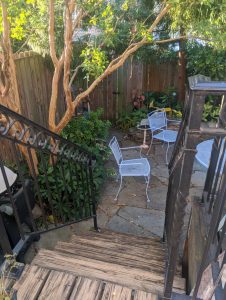
The kitchen leads to the much-used patio with a newly rebuilt stone garden wall (Ginkgo Gardens) and decorative steel railing built by Craftsman Ironworks. The garden was designed by Geoff Lindstrom.
The upstairs hallway also shows the owner’s love of art. His own drawings are on display on the wall. (Patrick serves on the board of the Capitol Hill Arts Workshop.) The oversized detail of Gustave Callebotte’s “Paris Street; Rainy Day” was once hanging along Michigan Avenue outside the Art Institute of Chicago.
 Down the hall, the master bedroom faux parchment paper wall treatment was done by Brian King, and the master bathroom skylight flaunts a “high flying” stained-glass kite, along with an extra-long claw-footed tub and wall spout. In the master bedroom, you see the beautiful sitting area that was opened up in 2014 to allow the historically accurate arched windows to be installed and the home brought back to original authenticity and beauty.
Jul 7, 2020 | Not on Home, Walking Tours
Since this scavenger hunt was originally published, in May 2020, several items have disappeared. We’ve left their pictures in place to acknowledge the amusement they provided but have noted their absence. As we become aware of others, we’ll update. Below are pictures of the items to seek. (more…)
Jul 2, 2020 | Not on Home, Participation in Community Events
Sadly, an in-person parade was not possible this year. But our good neighbors, Naval Lodge No. 4 and the Jeanne, Phil Meg Team at Compass Realty, weren’t about to let lapse one of our cherished community traditions – the Capitol Hill 4th of July Parade. They solicited and assembled video clips from the organizations that participate annually, to create this virtual parade. The CHRS contingent appears at 1:30. Many thanks to the event organizers!
Jun 18, 2020 | Calendar, Not on Home
We’re hoping you enjoyed the Whimsy of Capitol Hill Scavenger Hunt! If you’re looking for another free, fun, family-friendly, socially-distanced activity try out our new, self-guided Historic Sites Walking Tour.
(more…)

